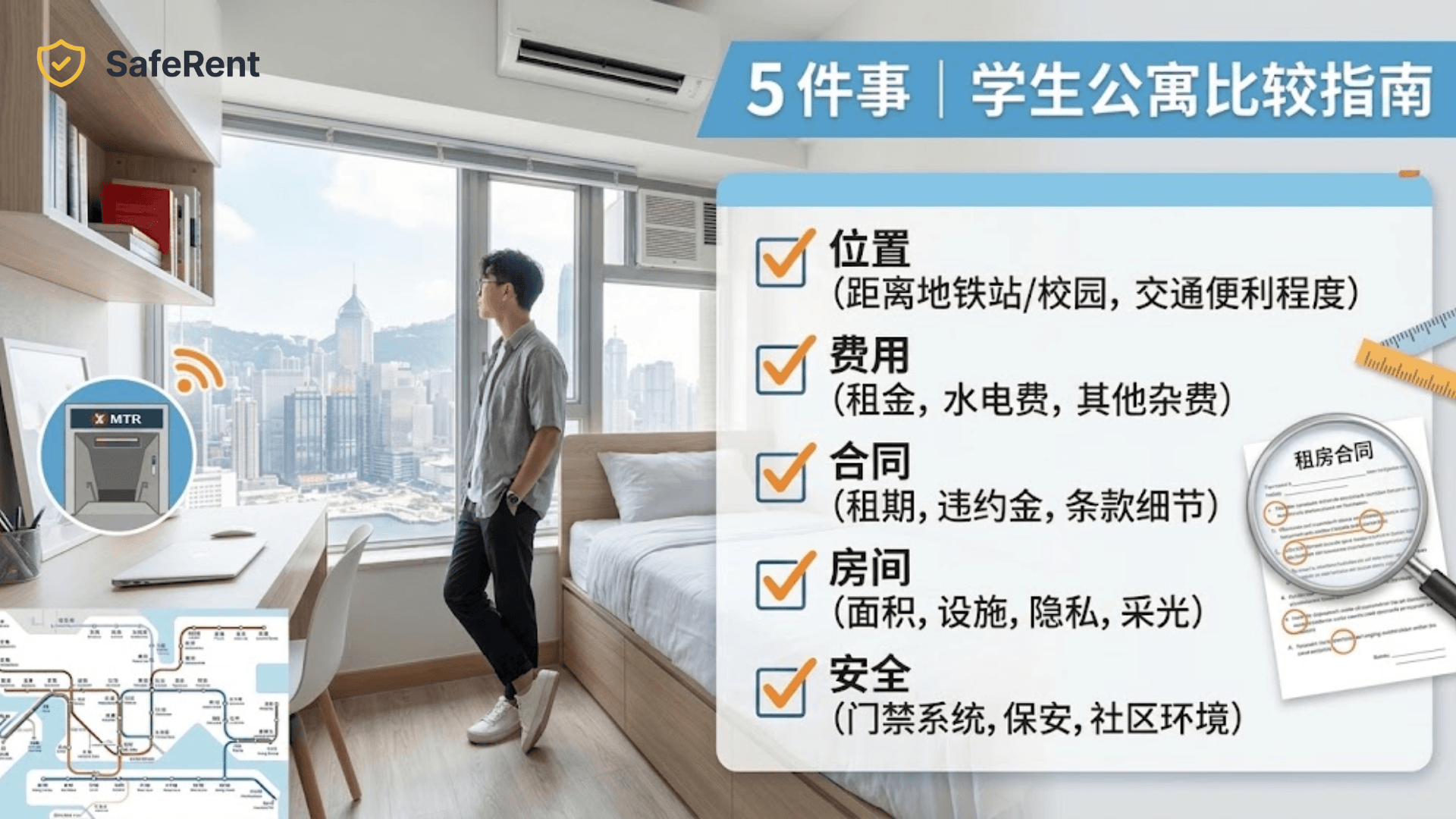
When looking for student accommodation in Hong Kong, it is easy to focus on claims such as “close to campus”, “move-in ready” or an attractive monthly rent. In practice, transfers, hidden charges, flatmate arrangements and overlooked contract terms often matter more after move-in.
Put the following five areas into one comparison table. The aim is not to find the listing with the best photographs, but the home that best fits your budget and daily routine for the coming year.
Set your non-negotiables first
Decide your maximum monthly budget, acceptable one-way commute, willingness to share and required tenancy length. Prices are only comparable when the underlying requirements are the same.
- Budget ceiling: combine rent, utilities, internet, management charges and transport.
- Commute ceiling: measure door-to-door travel during class-day peak hours.
- Room requirements: single or twin room, private or shared bathroom, and whether a mixed flat is acceptable.
- Tenancy period: full academic year, one semester or a summer extension.
1. Location and the real commute
Being three kilometres from campus does not guarantee a ten-minute journey. Hong Kong’s hills, interchange time and waiting time can add considerably to a commute. Search for the actual teaching building and compare routes at around 8 a.m. and 6 p.m.
- How long is the walk from the room to the MTR station or bus stop, and is it practical in rain?
- Are transfers required, and do last services work with evening classes and group projects?
- Are supermarkets, clinics, convenience stores and laundries nearby?
2. Total monthly cost, not rent alone
Some residences include utilities and internet; others charge separately for management, cleaning or air conditioning. Convert every option into a realistic monthly total before comparing it.
- Fixed costs: rent, management, internet and furniture rental.
- Variable costs: water, electricity, air conditioning, laundry and communal cleaning.
- One-off costs: deposit, service fees, tenancy stamp duty and move-in or move-out cleaning.
- Indirect costs: daily transport and the time lost to a long commute.
3. Contract, deposit and exit rules
Before signing, check the tenancy term, payment schedule, deposit return conditions, early termination and subletting rules. The Hong Kong Inland Revenue Department states that a property tenancy agreement generally has to be stamped within 30 days after execution. Confirm who will handle this and how the cost will be shared.
- Does the landlord or operator name match the payee and contracting party?
- When is the deposit returned, and what damage may be deducted?
- Can you cancel or transfer the tenancy if a visa or admission delay prevents move-in?
- What are the renewal and move-out notice periods, and what happens after late payment?
4. Room condition and shared space
Listing photographs usually show the best angles. During an in-person or live video viewing, inspect daylight, ventilation, noise and storage. For shared housing, confirm how many residents share the kitchen, refrigerator, bathroom and laundry facilities.
- Are the mattress, desk, wardrobe, air conditioner and water heater included, and who pays for faults?
- Can the window open, and is there dampness, mould smell or obvious noise?
- Are common areas cleaned regularly, with assigned refrigerator and cupboard space?
- Are there restrictions on visitors, overnight stays, cooking or quiet hours?
5. Safety, management and repairs
Student accommodation is both a room and a management service. Access control, fire safety, out-of-hours contacts and repair times all affect long-term peace of mind.
- Do the building and room have secure locks, access control and CCTV in communal areas?
- Are fire exits, smoke detectors and extinguishers clearly visible?
- Who handles leaks, power cuts or lock failures at night and on weekends?
- Are repairs charged, and what is the usual response time?
Quick viewing checklist
- Location: peak-hour door-to-door commute, last transport and nearby essentials.
- Costs: full-term price, inclusions, deposit and every one-off charge.
- Contract: term, exit, transfer, deposit return and stamping arrangements.
- Room: size, daylight, noise, furniture, number of sharers and cleaning rules.
- Management: access, fire safety, overnight contact, repair time and fees.
Frequently asked questions
Is purpose-built student accommodation always more expensive than a shared flat?
Not necessarily. Student accommodation may bundle furniture, internet and management, while a shared flat may add utilities, agency fees and furniture. Compare the cost over the whole tenancy.
Can I sign online before arriving in Hong Kong?
Yes, but first verify the operator or owner, property address and contracting party, and request a live video viewing. Put every refund, cancellation or transfer promise into the agreement.
What if the room does not match the listing after I sign?
Save photographs, video, the listing and messages, then contact the operator in writing immediately. For a serious dispute, consult current Hong Kong tenancy guidance and seek professional advice.
Official sources
- GovHK: Renting a Domestic Property
- Inland Revenue Department: Stamping of Tenancy Agreement FAQ
- GovHK: Methods of Stamping
Find the right base for you
The right student home is not necessarily the newest or nearest. It balances budget, commute, contract terms and daily habits. Asking each question before payment is usually much easier than resolving it after move-in.