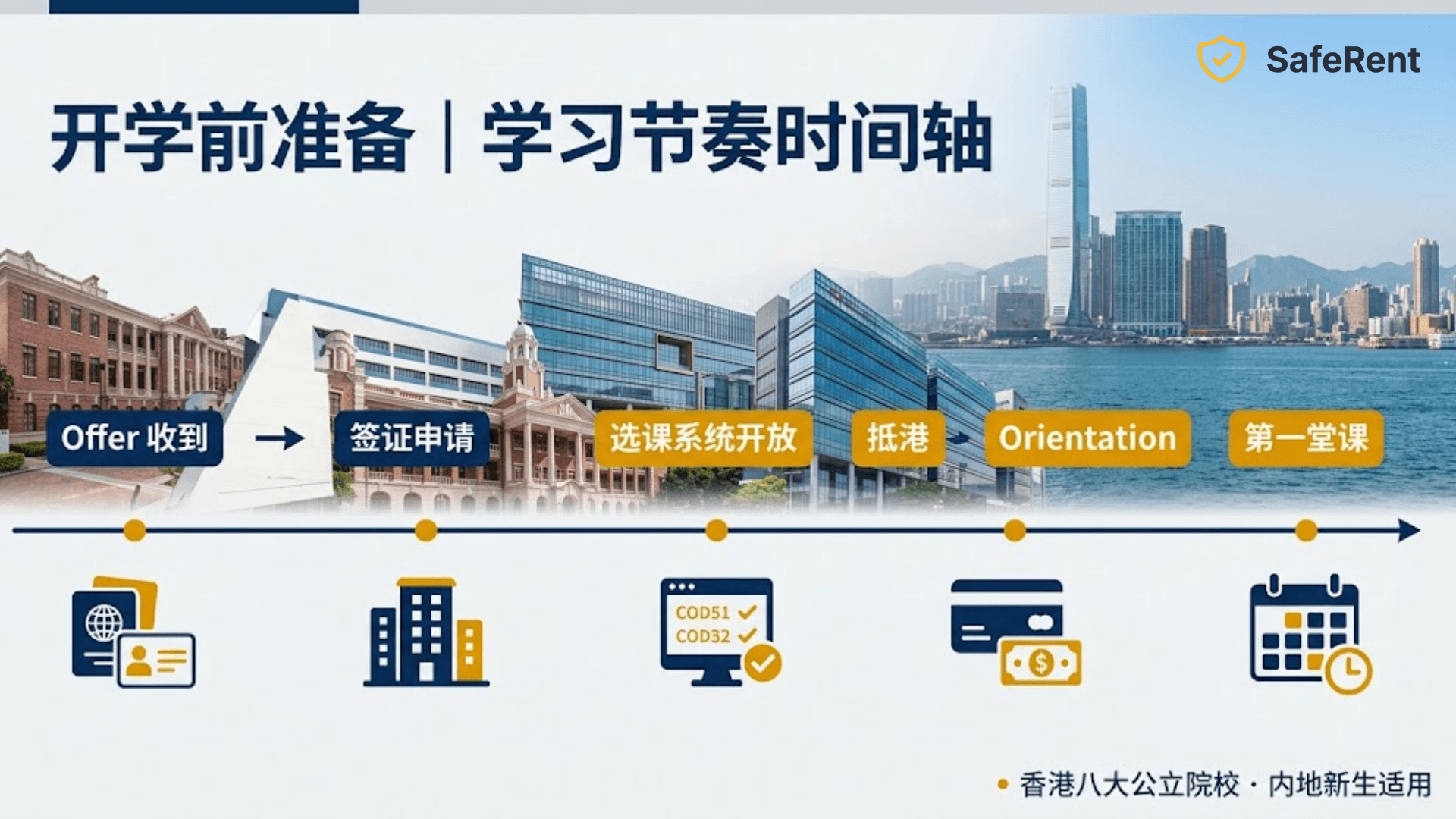
Preparing for university is not about completing everything at once. It is a sequence: confirm your immigration and accommodation arrangements first, complete registration and course planning next, then build a study routine for the first month. This guide is written mainly for students arriving from Mainland China. Dates, documents and assessment rules differ by institution and programme, so always follow your admitting university's email, student portal and official notices.
Your pre-arrival timeline
After accepting your offer
- Accept the offer and record the deadlines for deposits, tuition and registration.
- Submit the documents required for a study visa or entry permit. The admitting institution will normally act as, or help arrange, the local sponsor.
- Apply for university accommodation at the same time. For private accommodation, verify the landlord or operator, tenancy, deposit, payment schedule and move-out terms before paying.
- Create one master calendar using official dates only: visa, accommodation, registration, course selection, orientation, teaching and add/drop.
Two to six weeks before departure
- Confirm that you have your e-Visa, a valid Exit-entry Permit for Travelling to and from Hong Kong and Macao (EEP), and the relevant exit endorsement.
- Download offline copies of your offer, immigration, accommodation and insurance documents, and keep a paper backup.
- Complete online student registration, activate your student email and portal, and check for pre-registration or orientation tasks.
- Plan the route from your arrival point to your accommodation. Confirm check-in time, access rules and key collection with the hall or operator.
Immigration documents for students from Mainland China
Keep these items together in your hand luggage and do not rely on an app that requires an internet connection:
- A valid EEP.
- The e-Visa issued by the Hong Kong Immigration Department.
- The relevant exit endorsement issued by the Mainland authorities.
- Your offer, university contact details, accommodation confirmation and payment records.
- Identification, ID photos and any academic or health documents specifically requested by the university.
Hong Kong Immigration Department guidance states that a Mainland student should present the EEP bearing the relevant exit endorsement together with the e-Visa for arrival clearance. The e-Visa may be saved on a personal mobile device or printed on A4 paper.
Three priorities after arrival
- Check and keep your landing record or Landing Slip, including the correct immigration status and limit of stay.
- Complete student registration, collect your student card, and update your local telephone number and address in the student portal.
- If you are a new arrival aged 18 or above and permitted to stay for more than 180 days, register for a Hong Kong identity card within 30 days of arrival.
What to understand about university study rhythm
Hong Kong universities commonly organise teaching by term or semester, but teaching weeks, examinations, credits and grading scales are not identical. Instead of memorising one generic system, check the following in your own portal:
- Each course syllabus: learning outcomes, assessment weights, attendance, late submission and academic integrity.
- Your programme map: required courses, electives, prerequisites, graduation credits and the recommended load.
- Assessment formats: quizzes, midterms, finals, essays, presentations, group projects or participation.
- Key dates: registration, waitlists, add/drop, withdrawal, leave and examinations.
Add/drop is not a licence to over-register
The add/drop period and rules depend on the institution and course. If a popular class is full, follow the official waitlist or department process. Resolve timetable clashes, unmet prerequisites and an unrealistic workload within the formal deadline. Do not assume every university uses the first two teaching weeks or records withdrawals in the same way.
A first-month study system you can use
- One master calendar: enter every assessment and deadline, then work backwards to set preparation dates.
- A weekly review block: reserve time for each course to organise notes, resolve questions and preview the next class.
- The 48-hour question rule: if a point remains unclear for two days, take a specific question to the lecturer, tutor, academic adviser or learning support centre.
- A real commute buffer: test the door-to-door trip between your accommodation and classroom during a busy period.
- Group rules at the first meeting: agree on roles, the single source of files, internal deadlines and how absences will be handled.
Accommodation, money and daily life
Accommodation and study affect each other directly. When moving in, photograph the room, furniture, walls, windows, doors and shared areas. Keep your tenancy, payment records and maintenance messages. During the first week, confirm your late-evening route, laundry, cooking, internet and quiet study options before buying non-essential items.
Bank account documents and appointment methods vary by bank and individual circumstances. Prepare valid identification, immigration or student-status documents and proof of address, then check the bank's official requirements before applying. Do not keep large amounts of cash, all bank cards and original documents in one place.
Where to ask for help
- Immigration and non-local student matters: the International Office, Global Engagement Office or non-local student support team.
- Registration and courses: the Registry, programme office, department administrator or academic adviser.
- Accommodation: hall management, Residence Tutor, off-campus housing support or the named property manager.
- Academic difficulty: lecturers, tutors, academic advisers, language centres or learning support services.
- Wellbeing and adjustment: university counselling and mental-health services. Seek help early when stress begins to affect sleep, attendance or daily life.
- Emergencies: contact Hong Kong emergency services or campus security first, then notify the university and a trusted contact.
Final departure check
- Your e-Visa, EEP and relevant exit endorsement are ready and all personal details match.
- Accommodation, check-in date, address, key collection and an emergency contact are confirmed.
- Student registration is complete, or you know exactly how to complete it, and you can access student email and course systems.
- Official university deadlines are in one calendar with early reminders.
- Offline documents and separate paper backups are ready.
- You have allowed time after arrival for the student card, Hong Kong identity card and essential services.
- You have read at least the first-week materials and know how each course is assessed.
- You have saved the contacts for non-local student support, accommodation management and a trusted person.
Frequently asked questions
Must I print my e-Visa?
The Immigration Department accepts an e-Visa stored on a personal mobile device or printed on A4 paper. Carry an offline copy and a paper backup in case your device has no power or connection.
Is add/drop always during the first two teaching weeks?
No. Dates, waitlists and withdrawal records depend on the institution and course. Check your own student portal and Registry notices.
Do all Hong Kong universities use the same GPA scale?
No. Grade scales, GPA conversion, pass requirements and honours classifications can differ. Use your university regulations and each course syllabus.
When should I apply for a Hong Kong identity card?
A new arrival aged 18 or above who is permitted to stay for more than 180 days must register within 30 days of arrival. Check the Immigration Department rules if a different age or status applies to you.
Official information and further reading
- Hong Kong Immigration Department: Study in Hong Kong
- Hong Kong Immigration Department: Immigration policy on study FAQ
- Hong Kong Immigration Department: Identity card registration
- The University of Hong Kong: Non-local student welcome guide
- The Chinese University of Hong Kong: 2026 registration and course guide
- The Hong Kong Polytechnic University: 2026/27 pre-arrival information